
 The Telegraph

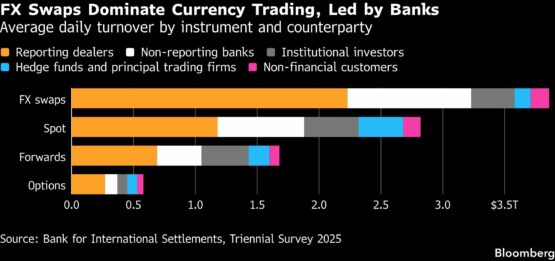
The $4 trillion-a-day currency swaps market is working to lessen its reliance on dealers making phone calls, as trading platforms seek to automate this historically manual sector of foreign exchange.
Currently, about 56% of FX swaps are traded electronically, markedly lower than the approximately 71% of spot transactions, as per the Bank for International Settlements. This gap is particularly evident in the inter-bank market, where traders frequently rely on voice brokers to handle large positions.
There is now renewed momentum to shift more of this business to electronic trading, as emphasized during an industry event in Amsterdam. Technology provider 360T expects to see a rise in trading on its electronic platform next year, while the London Stock Exchange Group Plc plans to launch a clearing solution.
Market structural consultancy Positive Sum Associates reported that at least three venues are developing platforms for dealer-to-dealer swaps.
“The race is on,” stated Jasper Livingsmith, founder of Positive Sum Associates and former head of G7 portfolio management at the European Bank for Reconstruction and Development. “It surprises me that such an old, traditional marketplace remains so primitive.”
Automating FX swaps introduces distinct challenges as they entail two currency transactions occurring on different dates and are influenced by the extent of credit banks are willing to extend to one another.
ADVERTISEMENT
CONTINUE READING BELOW
While greater automation could pose a threat to some broker roles, reducing trading costs remains a vital objective in the largest segment of the currency market.
According to Alexis Cayla, head of quantitative G-10 short term interest-rate trading at JPMorgan Chase & Co., advocating for an “electronification” of the dealer-to-dealer swaps market is crucial for top liquidity providers.
The US bank is undergoing this change itself, but the overall pace of transformation in the industry will depend on other banks’ readiness to adapt.
Read: Ignoring tech issues costs financial services industry millions every year
Still human
This is a familiar story. Conference participants have long believed that FX swaps would ultimately mirror spot trading by entering the electronic age. However, many attendees in Amsterdam were hesitant to make such predictions again, having witnessed the industry repeatedly assert that change was just around the corner.
Some still value human interaction in currency markets. Panelists raised concerns about the decline in phone conversations, while AI-generated summaries risk making communication feel less personal.
ADVERTISEMENT:
CONTINUE READING BELOW
Others jokingly suggested that AI bots could be programmed to chat about the latest football scores, filling the void left by reducing social interactions with brokers.
Read: Microsoft launches AI that works like an executive assistant
Some funds have already started automating smaller swaps transactions. Ian Packer, an FX trader at UBS Asset Management, mentioned that up to $500 million in major currencies can now be managed electronically, whereas larger transactions still require direct calls.
“For significant swaps, we often need to execute things manually due to our banking counterparts lacking sufficiently advanced systems,” explained Richard Turner, senior trader at Insight Investment. “We are eager to implement more automation.”
Bloomberg LP, the parent company of Bloomberg News, manages a currency trading platform that incorporates swaps.
© 2026 Bloomberg


